The History Of The Hall
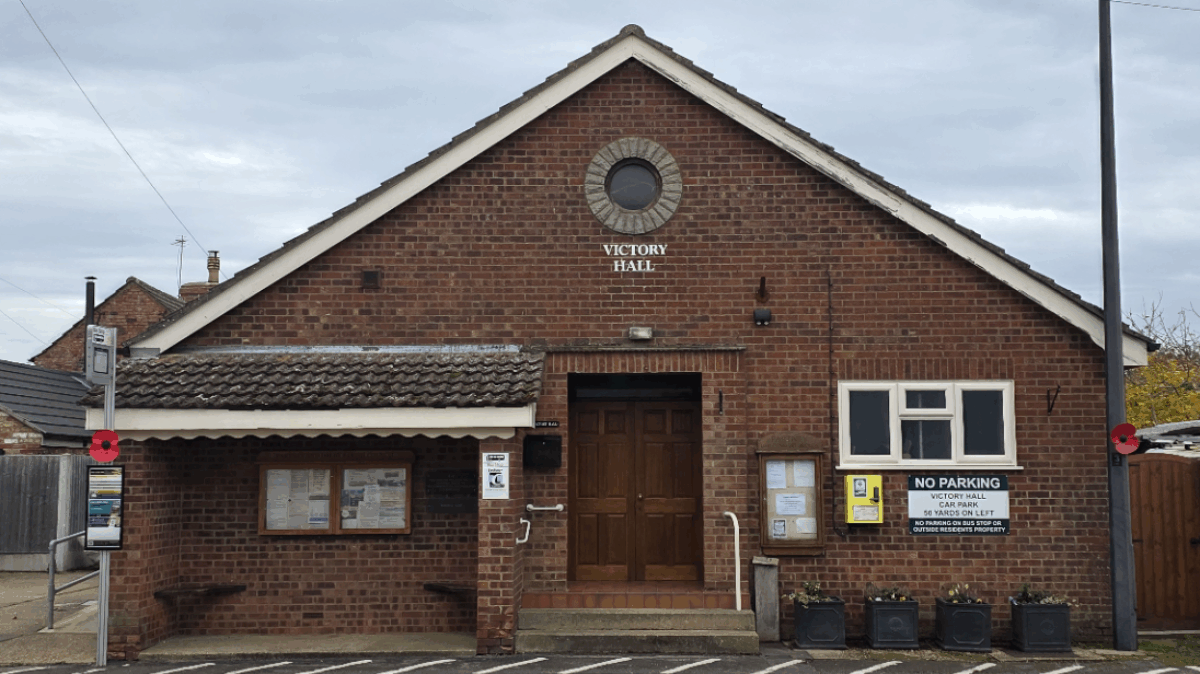
The Victory Hall in Partney was built as a memorial to the men of the villages of Partney, Dalby and Dexthorpe who had served in the Great War.
The villagers first met in 1918 to decide on a fitting memorial to the 55 men associated with the villages who had served their country. It would be called the Partney, Dalby & Dexthorpe Victory Memorial Hall. A memorial listing all the names of the men had been erected in St Nicholas Church. At first a list of 55 names seems a tremendous response from a village of 268 residents but the memorial includes men who lived in the village at the outbreak of war as well as men who had lived in the village prior and after the war.
A Buildings Sub-Committee was formed and a search carried out for a suitable site. They settled on the White Horse Inn on Skegness Road opposite the Red Lion Inn. A Partney resident, Mrs Zoe Bidgood gave the sum of £150 so that the property could be purchased from the brewers, Soulby Sons and Winch of Alford. The value of the £150 purchase price today is about £45,000.
The White Horse had seen trade fall and was closed before the outbreak of War in 1914. The site was used as a German prisoner of war camp during the First World War. We know this from articles in the Times newspaper – in 1918 Edna Portass, of Mavis Enderby, and Robert Houghton, farm labourer, of the same place, were summoned at Spilsby, Lincolnshire, Petty Sessions for conveying 1s 6d in money to a German prisoner of war which was likely to facilitate his escape. They pleaded “Guilty,” and it was admitted they gave the money to a Prussian guardsman for him to make them silver rings, which they in due course received. The camp commandant said that he wanted to impress on those persons that their conduct in purchasing rings, or even accepting them as presents from the prisoners, made the administration of the camp harder for all concerned, and if it continued it meant that the benefit which farmers were receiving from prisoners of war would have to be taken away. The defendants were fined £1 each.
Partney was one of 600 Prisoner of War camps and was probably a working camp attached to a parent camp. Prisoners would have been house in bell tents behind barbed wire fences. It may well have been created for a specific work project and housed about a dozen men. The German military prisoners of war were made to work whilst in captivity. One of the jobs they carried out in Partney was to build a Dutch barn for the Bugg family of Valley House in Partney. Charles Bugg was a thrashing machine owner and is recorded as such in both the 1926 and 1930 editions of the Kelly’s Lincolnshire Directory.
The building of the Victory Hall was led by a committee of Trustees chaired by Major Bartholomew Clazpon Garfit of Dalby Hall. It was decided that the interior measurements of the Hall should be 25 feet by 50 feet with ante-rooms, entrance, stage, kitchen and dressing room. Subscriptions were sought from residents to raise funds for the building works. A number of residents made loans of £50 to £100, many of whom had relatives who had fought and died in the War. Additional funds were raised by selling off the materials from the demolished White Horse at 2/6 a single load and 3/6 for a two horse load. A total of £1200 was raised – about £300,000 today.
Estimates were obtained for the new building which came in at £1230. It was therefore decided to do without a toilet to bring the cost down to £1200.
A men’s club was formed in August 1921 but they were a constant thorn during the early years of the Hall. They would often not pay for the coke for the fire or the electric for the lights or any breakages they caused. Indeed, at a meeting on 14th October 1927 the secretary was empowered to close down the Club if it was not properly conducted.
At this time the Hall was used for regular Whist Drives, Young Farmers Club meetings and the Mens Club. A Youth club was held two nights a week and the Partney & Dalby W.I. used the Hall for their meetings. And of course there were wedding receptions and parties held there.
During the Second World War a number of troops were stationed in Partney. Like a lot of country houses, Partney Hall had been requisitioned by the army for troops returning from Dunkirk in June 1940 for training and housing ready for an invasion of France. The fields surrounding the Hall were filled with tents and part of the grounds was turned into an assault course. Local boys would finish school and dash across to the Hall to have a go on the assault course.
The people of Partney soon realised that the troops stationed in the village needed somewhere to relax so a committee was formed to turn the Victory Hall into a Canteen. The first meeting was held on July 8th 1940 and the Victory Hall was hired at the rate of 10/- a week inclusive of electric and paraffin. It was decided that light refreshments be offered but not cigarettes and that everything possible be bought from the village shops. The decision not to sell cigarettes was later rescinded after pressure from the troops. The canteen would open on Sundays from 2pm to 10pm, Mondays 6pm to 10pm and all other days 2pm to10pm. Games and cards were offered along with daily papers and notepaper was on sale. Whist Drives and dances were held with the occasional concerts put on by the soldiers and the villagers. The entertainments put on by the troops were free as a mark of appreciation of the canteen.
A Committee meeting on 3rd November 1942 was told that Captain McCaffrey wished to express his warm thanks to the helpers for all they had done for the Suffolks during their time in the village. He said it was impossible to say how much the men had appreciated the Canteen and the friendly service they had received in it.
On July 19th 1944 all the troops left the village and a meeting of the Committee on 29th September 1944 decided to hand the Hall back to the village thereby closing an important chapter in the life of the village and Hall. A letter of thanks was received from the Head of Northern Command.
The Hall continued to be used regularly by the villagers including Dances on a Friday night run by Mrs Riley. These are well remembered by locals – music was provided by a Blind Boys Band with piano accompaniment from Mrs Johnson, mother of Simon the butcher. They would listen to the latest dance tunes on the radio and practise them ready for the next week’s dance.
In the early 1980s the Young Farmers were putting on one of their regular entertainment shows. As usual it was an energy packed show and at one point one of the chaps fell backwards, hit the wall and carried on out into the fresh air! The Committee realised that the Hall needed an urgent upgrade.
In a scene reminiscent of the building of the original Hall local residents gave interest free loans to pay for a complete rebuilding of the Hall. The only problem was, it was so well used they didn’t want to shut for any length of time. The answer was to build the new Hall around the old structure and when complete, demolish the original from the inside.
At the time the Job Centre was running its Manpower Services Commission where the skilled unemployed could be used on schemes such as the Victory Hall. The labour for the rebuilding was therefore provided for free.
The Hall you see today was completed in 1986. If you measure the internal space it is a few inches larger than specified by Major Garfit all those years ago. Look above and you see what appear to be 4 very small loft hatches. They are the vents for he stoves now no longer required. The Hall was closed for just one day throughout the rebuild whilst the new toilets were connected to the sewer, a magnificent feat.
The Hall was reopened in 1986 by Miss Maddison, the daughter of the last squire of Partney, Major Maddison.
During the first 90 years of the Hall it had just four caretakers who resided in the Caretakers Cottage adjacent to the Hall. Partney was probably the only village in the County to have a caretaker’s cottage. The Staintons were caretakers from its opening to 1950, then the Barnwells for a couple of years followed by Don and Mary Spence who undertook the job for 58 years. The changes in the use of the Hall meant the Committee decided a caretaker was no longer necessary and the Cottage was sold and the money used to improve the Hall.
Today the Hall continues to be used regularly. There are dance classes, choir rehearsal, a weekly Coffee Morning and flower arranging classes in the winter. There are also occasional Film Shows and of course parties.
.